
Here is some of the work from our students at the Stelle 2010 PDC.
Permaculture Certification Course
October 9-16, 2010
Permaculture Design Team
Noah Madlin, Michelle Pohlman, Sophia Rog,
Kurt Rowe, Emma Schroeder, Kimberly Waller
Client
Kasandra Ireland
Stelle, IL
Introduction
The October 2010 Permaculture Design Certification Course team members: Noah Madlin, Michelle Pohlman, Sophia Rog, Kurt Rowe, Emma Schroeder, and Kimberly Waller are pleased to present our Permaculture design for the property of Kasandra Ireland residing at 110 Sun Street, Stelle, IL 60919.
We have incorporated many of the Permaculture ideas, concepts and related thoughts synthesized among and between our course members throughout this week of study into the following pages.
We hope that your journey into actualizing our created vision for your property is as fun and exciting as our journey into Permaculture Design has been.
Client’s Goals
1. Eliminate water overflow in backyard and along walkway from garage to back door.
2. Tear down back deck, raise ground level, and put in a patio.
3. Beautiful, multifunctional flowers.
4. No grass to mow.
5. A pond: frogs, fish…
6. Celtic aesthetic: spirals, circles, knots, labyrinth…
7. Removal of some trees in back yard for additional sun.
Assessment and Approach
Our assessment of the property included:
• A walk on the site
• Measurements of property boundaries and built environment
• Inventory of existing plant communities
• Calculation of water harvest potential and storage
Our approach to Design included:
• Applying the scale of permanence
• Brainstorm ideas for movement of water on the property
• Incorporate Client Goals
• Integrate zones into areas of the property
Climate, Topology, and Water
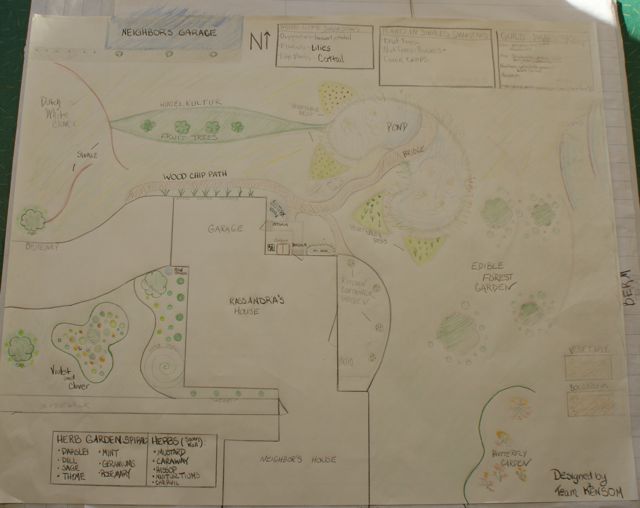
The watershed and slope for this property begins at the high point at the East/South-east portion of the property along a common area berm and the edge of the community and drains through our food forest (Siberian Elm, Cottonwood, River Birch, and Honey Locust). The general slope is towards the West/Northwest. Currently much of the water flows from this high point and from the rooftop to the lower areas of the backyard closer to the house and in the area common and between Cassandra and Peg’s property. The slope continues moving water between the two properties towards the front of the house.
Annual precipitation for this part of Illinois is approximately 34.47 inches per year on average.
In an effort to capture, slow, and move the water on the property and to assist in correcting flooding and standing water in low areas, we recommend and have included the following into our design …
• Create swales on contour, high on the berm (if possible) or at the property line in the food forest to slow water and provide for groundwater recharge.
• A pond to the west of the food forest, near the neighbor’s property boundary and adjacent to the existing in-ground cistern. Excavated fill from the pond will be used for the area near the house where the deck is being removed and a patio created.
• The existing in-ground cistern is approximately 3’ in diameter and was measured to a depth of at least 8’. This provides a minimum storage capacity of approximately 425 gallons. ( See Appendix A ) It will provide a dual function. First, allowing for manually filling watering cans for manual with the repaired and functioning hand pump. Second, the addition of a solar-powered submersible pump will provide a steady water source to the pond. An optional float sensor in the pond could help maintain a stable water level. An aerator could prevent pond stagnation and minimize mosquito populations.
• Maximize capture and storage of rainwater ( See Appendix B )
o Downspout from rear corner of house near patio and kitchen gardens fills the in-ground cistern.
o Downspout from rear of garage fills 1,000 gal above ground cistern
o North front yard (left of garage) drains to swales.
o South front yard (right of garage from street) drains into rain barrel with overflow flowing out into hugelkultur celtic-knot beds.
• Pond overflow moves westward in the property into “The Land Between” and a series of hugelkultur beds. Excess water from these beds would move out into swales in north front yard.
Food Forest
Farther back in the property there is a honey locust, a River Birch, a
Cottonwood and two Elm. This area could potentially be designed into a
food forest, with nut trees and a healthy understory that would help
soil health and attract wildlife. We recommend removing the two elm
trees at the back of the property, opening up this area for sun and
the possibility of more extensive vegetable gardens.
Patio and Kitchen Gardens
After removing the disintegrating deck, we will raise that area so
that water does not collect near the foundation and will instead flow
towards the pond. A patio outside the sliding doors will be edged by
kitchen garden beds interspersed with halved whiskey barrels, a
resource that is already sitting on the property. These beds will
continue out towards the pond and the mulberry tree, getting larger as
they move away from the house. Eventually a kind of pergola or trellis
around this patio could hold grapes or other vines (kiwi, green beans,
morning glories).
Pond
As another zone 2 feature, visited for enjoyment, harvesting, the occasional dip, could be a pond.
The pond acts as another water catchment area filling from the higher swale’s overflow, rainwater and pumped water from the cistern. A pond is a habitat for potential aquatic life, edible, oxygen fixing, water filtering and nutrient enriching plants at various levels of the pond. The edge zone around the pond is a habitat as well for toads, frogs, bugs etc.
Suggested plants: For aerators that would be submerged – hornwort or coontail could be food for animals, add oxygen for fish and other aquatic life, and lends a hand to limiting algae blooms.
Floating Plants that could be used would be water lilies, being habitats, and edible along with bulrush/cattails which prefers shallow waters, is edible, can seeded in the fall, and secures the . An overflow from the pond will lead to the hugelkultur bed along the side of the house.
The Land Between
This is the piece of the property that lies between the front yard and
the pond (east-west) and Kasandra’s house and her neighbor, Peg’s. We
suggest that this area consist of a run-over area for the pond, and a
hugelkultur bed to regenerate soil. This area will run smoothly into
the fruit trees that run between the two garages.
North Front Garden
For the North front garden we recommend two swales—a path will run
between the two and connect the main path that will run from the top
of the driveway to the back door. These swales will slow and help
utilize the water that comes from the downspout on the north west
corner of the garage. We suggest the following plants in this area, as
a guild with the Ash tree in the southwest corn of this yard space:
currents, gooseberries and raspberries below the two swales; beds
interspersed with strawberries, parsley, and spring bulbs. Also, these
beds can be developed in many different ways and with a variety of
plants. This area continues back in a narrow shape between the garage
and the neighbors garage. This area could be planted with fruit trees,
or with a cover crop of white clover to help the soil heath for
planting down the road.
South Front Garden
This garden includes already a Hawthorne tree and an oak tree. Another
(semi) permanent feature is the downspout on the southwest corner of
the garage. In the area below the south facing wall by the front door,
we recommend an herb garden, flowing into a spiral patterns as it
spills onto the top of the lawn. This garden can be planted with a
variety of herbs as Kasandra chooses: mint, basil, parsley, majoram,
thyme, rosemary, etc. We suggest that the coniferous bush in front of
the window be removed, and that this area be filled rhubarb plants,
Japanese Barberry, and Rosa Rugosa. In the center of the lawn we can
build hugelkultures in an aesthetically pleasing, celtic-knot design.
One option for these beds is an Asian Pear garden: Two dwarf asian
pears, lovage, peppermints, nestertium, parsley, echinacea, fava
beans, marigolds. A guild aroud the oak tree in the corner would
consist of Pau-Pau, Hazelnut, Goumi, Comfrey, spring bulbs and
strawberries. A rain barrel under the downspout could overflow onto the
lawn and run towards these various plants, and in times of less rain,
this water could be used for manual watering of the front lawn as it
needs.
Recycled Materials
Deck – Pending the condition of the wood, this could be used to build more garden beds, pergolas over the walkways, and a bridge over the pond.
The Whiskey barrels by the house could be turned into container gardening on the patio.
The Elms in the east are diseased. 1 or 2 could be cut and used for hugelkultur. Also the brush pile could be used for hugelkultur around the plot.
Bibliography
• soils.usda.gov/survey/online_surveys/illinois/IL053/for.pat
• www.sare.org
• www.standingupforillionois.org/cleanwater/rg_native.php
• permaculture.org/au
Appendix A
In-Ground Cistern
Diameter: 3’
Depth: 8’ or deeper
Volume of a Cylinder: V = π x (radius)2 x height
V = 3.1416 x (18”)2 x 96”
V = 97,716 cu in.
231 cu in = 1 gallon
97,716 cu in/231 cu in per gal. = ~423 gallons
Appendix B
Water Harvesting Potential for the Property
Calculating Rainwater Harvesting Potential
How to estimate annual water supply:
• Collection Area (sq. ft) x Rainfall (in/yr.)
/ 12 (in/ft) = Cubic Feet of Water/Year
• Cubic Feet/Year x 7.43 (Gallons/Cubic Foot) = Gallons/Year
Example: a 500 sq ft roof that gets 36 in/yr will produce 1,500 cu ft
or 11,145 gal / yr of water.
Garage:
24’ x 24’ = 576 sq ft (AREA)
576 sq ft x Average Rainfall 34.47 in/yr = 19,854.72
/ 12 in/ft = 1,654.56 cu ft per year
1,654.56 cu ft/yr x 7.43 gal/cu ft =
12,293.38 gal/yr
House:
46.5’ x 26’ = 1209 sq ft (AREA)
1209 sq ft x Rainfall 34.47 in/yr = 41,674.23
/ 12 in. ft. = 3,472.85 cu ft per year
3,472.85 cu ft/yr x 7.43 gal/cu ft =
25,803 gal/yr
Total Potential Annual Rainwater Harvesting = 38,096 gallons
Above Ground Cistern
Source: http://www.loomistank.com/plastic-water-tanks.shtml
1,000 gallon Snyder Industries Vertical Water Storage Tanks
Weight: 200 lbs; Diameter: 60″; Height: 89″ Standard Ftg: 2″ btm only; Lid: 18″