
Koinonia PDC September 2010
Old Dawson Patch Site Design
Client: Koinonia Farm
Designers:
Amanda Moore
Eliza Greenman
Michael Gregory
Bill Holland
Chris Lutz
Jessamine Hyatt
Vision
Throughout their existence, the grapes and blueberries have often been one of the least managed crops on Koinonia’s farm. Our vision is to revitalize and diversify this area for community use, educational outreach, building and strengthening local and regional relationships, ease of healthy and sustainable land management, as well as economic benefit for Koinonia Farm.
History
Since Koinonia purchased the fields encompassing this patch in the late 40s- early 50s, it’s been row cropped with peanuts, corn, cotton, wheat, oats, and once a 50-acre field of sweet potatoes. The farming practices have varied—from an almost organic management to heavy chemical management with pesticides and herbicides. A peach orchard was planted and abandoned, perhaps even before the grapes were planted in 1976. The blueberries were planted sometime between 1976-78. The grapes themselves have been sprayed with various fungicides throughout the years. In 2002, the fields East of the site were sold to a neighbor farmer. It has since been sold again twice, with the current owner living 30 minutes away. The crop varies from year to year, but typically includes cotton, peanuts, and hay.
Currently the blueberries and grapes receive minimal management, but are pruned yearly with the exception of the southeast grape plot, which is not managed at all. Most labor is provided by community members and visitors. The client has an existing U-Pick market as well as other local markets. The Scuppernong variety tends to be most popular among the local U-Pick customers and blueberries are most popular with those who have moved to the region.
Koinonia holds a strong commitment to sustainable agriculture, so any suggestions for this site seek to advance this commitment. Koinonia is also committed to diversity of community involvement. This site design seeks to enhance relationships with local and regional communities as well as building new relationships through educational and other fellowship opportunities.
Koinonia’s existing Development plan includes the program “Adopt a Tree,” which could help provide funds for this project. It is recommended that the client seek opportunities to benefit from this existing structure.
Geographic Summary:
Sumter County is located in Georgia’s Upper Coastal Plain, 150 miles north of the Gulf of Mexico. Located in southwest Georgia, Sumter County typically has a warm, humid climate characterized by long hot summers and short mild winters. A typical summer day (June through August) has an early morning temperature in the low 70’s and an afternoon high in the mid 90’s. August is the hottest month of the year, with an average daily temperature of 91 degrees. During this summer period, the temperature can rise to 100 degrees or more for 5 or 6 days. Historically speaking, moist air from the Gulf of Mexico causes a high incidence of cumulus clouds and frequent afternoon thundershowers, lowering the daily temperatures but increasing the humidity in the area. The relatively mild winters have an average of 35 days at or below freezing, with only 2-3 days expected in the lower 20’s. The freeze-free season extends from Mid-March to Mid-November, an average of 245 freeze-free days.
Annual rainfall averages 50 inches, with the highest amount occurring in March and July, of 5 inches or more. The months of October and November have the least amount of rainfall, often less than 3 inches. July’s rainfall is attributed to thundershowers, while March’s rainfall comes from low-pressure systems moving from the Southwest to the Northwest. Snowfall is unusual in the area, with an average yearly accumulation of .2 inches.
Site Summary:
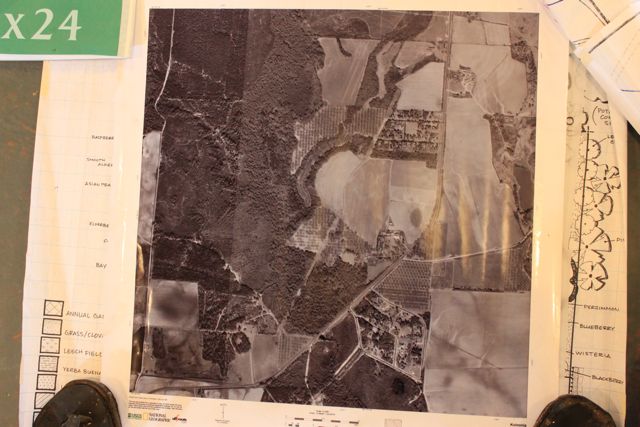
The study site is located in zone 3, which represents an area removed from the living area and managed with minimal inputs. It is comprised of 9 acres containing old vineyards and blueberry fields. This site is located to the east of the Chapel and Elliot pecan orchard, perpendicular to Old Dawson Road, approximately 700 feet east of Highway 49. Access can be obtained from Old Dawson Road. The elevation is approximately 400 feet with a 2% eastern facing slope. To the east, the site borders a non-organic farm that is in an undetermined rotation.
Soil:
Soils are part of the Red Bay Series, a sand-clay loam mixture with a dark-reddish-brown color. These soils are well drained with a slope between 2 and 5%. On average, there is an 80-inch depth to the water table and drilled wells on the property are around 300 feet deep. Because of a low content in soil organic matter and a pH between 5.1 to 5.5 (acid), the soil fertility of this site is low. The bedrock is comprised of marine deposits from the cretaceous geologic period (144 to 65 million years ago).
Vegetation:
The site is comprised of vineyards, blueberries, and an assortment of opportunistic species covering areas of disturbance or neglect. The vineyards are comprised of the scuppernong grape variety (Vitis rotundifolia), a native grape to the coastal plain areas of the Southeastern US. The scuppernong grape is bronze colored and large in size, growing 2 to 10 in a bunch. The blueberry fields consist of at least two varieties of rabbiteye (Vaccinium ashei). These varieties are native to the Southeastern US and widely grown as a commercial crop. To name a few, the opportunistic species throughout the site consist of privet (Ligustrum vulgare), poke weed (Phytolacca americana), Chinaberry (Melia azedarach), Japanese honeysuckle (Lonicera japonica), lambs quarters (Chenopodium spp) and a large area is covered in Bermuda grass (Cynodon dactylon). There are also various pecan (Carya illionensis) saplings which have established themselves from the neighboring pecan orchard.
Water:
Irrigation water is available from a non-potable well near the site. A drip irrigation system is in place throughout the blueberries and has been set-up in the vineyards in the past. Other sources of water come from the gentle eastward slope of the property, where rain from up-slope washes-over during periods of high rainfall.
Surrounding Habitat:
The Muckaloochee creek bed, located 1/4 mile from the study site, is a sensitive habitiat serving as a wildlife corridor. Wildlife present on the property includes deer, beaver, opossum, armadillo, coyote, bobcat, fox, and a wide array of birds, amphibians, reptiles and insect life.
THE PERMACULTURE DESIGN:
Site Description:
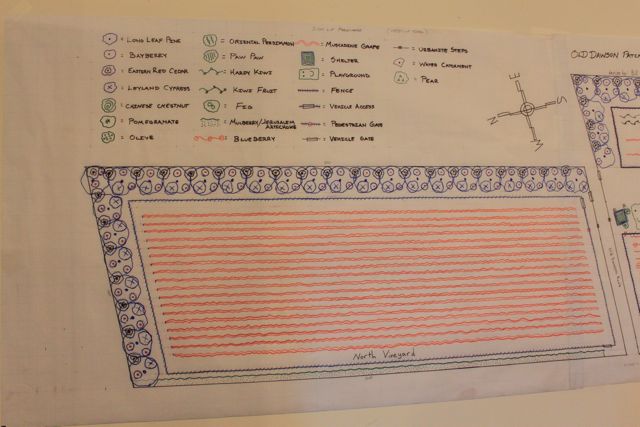
The 9-acre design site is bisected by Old Dawson Road, creating vineyards on the north and south sides. The north vineyard covers an area of 4 acres planted in Muscadine (Scuppernong grapes). These grape vines are planted in 21 rows generally heading in a North-South direction, perpendicular to the road. The rows are 12 feet apart and the vines are planted 20 feet apart within these rows. Pecan orchards border the vineyard to the west, which are client owned. To the east lay row cropped agricultural fields, which are planted in an undetermined rotation of cotton, peanuts, soybeans and hay, but are currently covered in cotton.
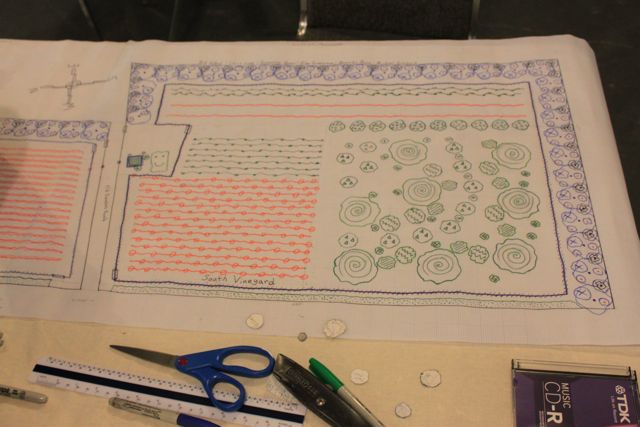
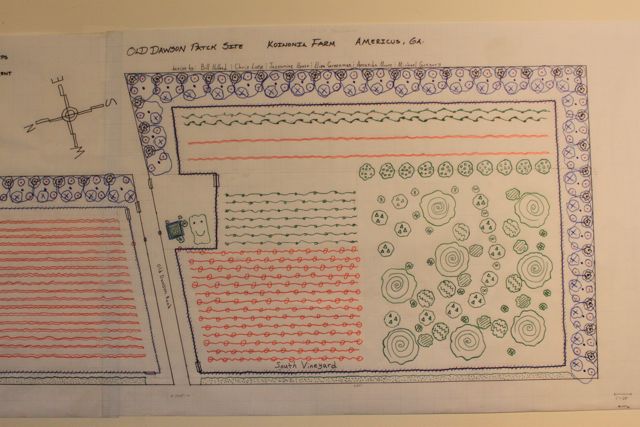
The south side of the road contains a 2-acre vineyard, 1 acre of blueberries and a 2.5-acre transitional section, which used to be in peaches and blackberries but now covered in early successional species. The blueberry patch is located on the western edge of the site and consists of 15 rows (roughly 600 plants) of rabbit eye blueberries (Vaccinium ashei). The two-acre vineyard is comprised of 11 rows placed 14 feet apart, with a vine spacing of 16 feet in each row.
Income generation:
The first two rows of the north vineyard, and the blueberry fields are currently under “U-Pick” use, allowing people to come and pick blueberries and grapes by the pound. Community residents also pick these crops for use in a variety of value-added products and community consumption. Some crops are sold in Koinonia’s on-site retail store and others in local markets. Though financial and harvest records were incomplete for the 2010 year, our research indicates an income of approximately $3500.00.
Observations and Client Needs:
A series of interviews conducted with residents and staff revealed a variety of attitudes towards the site designs, ranging from a strong desire for renovation and improvement to an enthusiasm for transitioning the space out of it’s current use.
Site observations revealed a level of neglect in the southern sections of the blueberries and muscadines. This area posed the largest design challenge due to the uncertainty surrounding its future use.
The client would like to incorporate livestock into the site for grazing management.
Based on these observations and client needs, the following goals, assets and obstacles are recommended for the site.
Goals
1. Land Management
Primary:
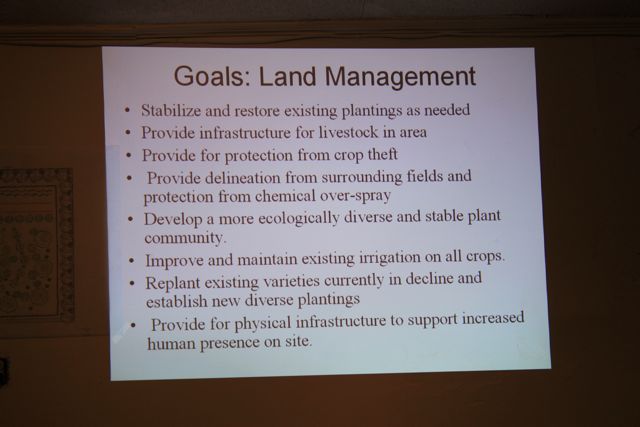
Stabilize and restore existing plantings as needed; Provide infrastructure for livestock in area; Provide for protection from crop theft; Provide delineation from surrounding fields and protection from chemical over-spray; Develop a more ecologically diverse and stable plant community; Improve and maintain existing irrigation on all crops.
Secondary:
Replant existing varieties currently in decline and establish new diverse plantings; Provide for physical infrastructure to support increased human presence on site.
2. Community
Primary:
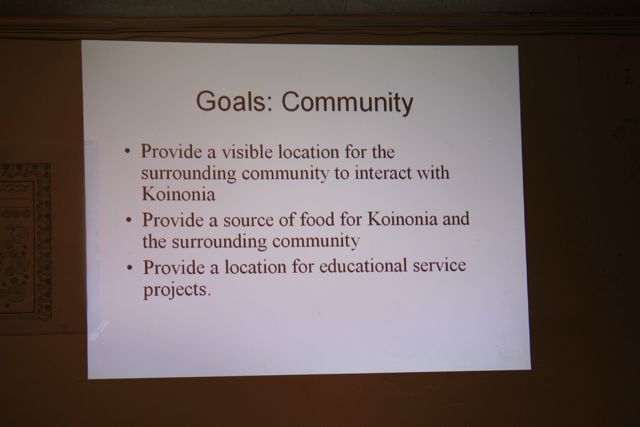
Provide a visible location for the surrounding community to interact with Koinonia;
Provide a source of food for Koinonia and the surrounding community;
Provide a location for educational service projects.
3. Economic Benefit
Primary:
Provide a source of income for Koinonia through the sale of fresh crops and value added products; Reduce need for outside food purchases; Providing a more diversified and less labor intensive crop schedule. Support the local economy.
Assets
* Existing plantings are producing well
* On site opportunities for plant propagation
* Irrigation infrastructure is mostly in place
* Soil profile is relatively stable/ little erosion evident
* Close to central campus and housing and road access
* Existing business in place
* Community awareness of crop availability
* Existing value-added products business on site with infrastructure in place
* Large amounts of volunteer labor occasionally available
* Compatible livestock is already on-farm and available
* Expertise and some materials are available for infrastructure improvements
Obstacles
* Time intensive large plantings can be a strain on labor resources
* History of crop theft
* Chemical drift from neighboring fields
* Existing plantings may be reaching the end of their productive lives
* Necessary financial inputs may not be available
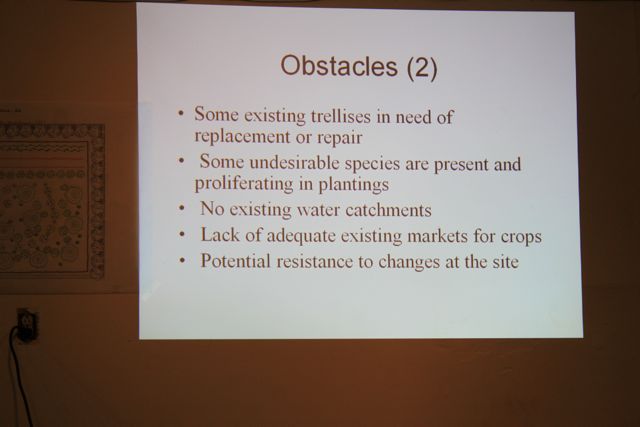
* Some existing trellises in need of replacement or repair
* Some undesirable species are present and proliferating in plantings
* No existing water catchments
* Lack of adequate existing markets for crops
* Potential resistance to changes at the site
Recommendations:
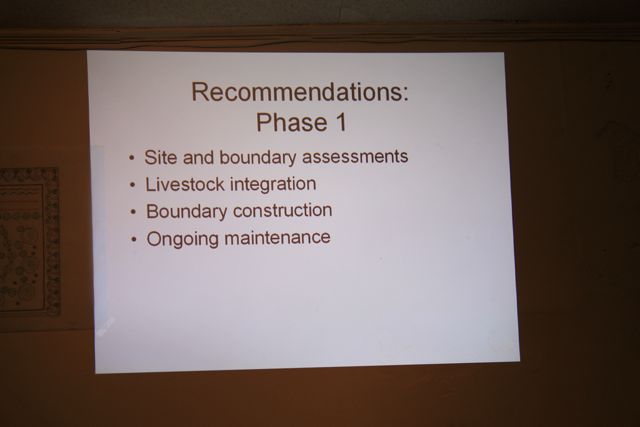
The three suggested segments of this permaculture design, phases 1, 2 and 3, are presented with recommendation to be completed in numerical phase order. Phase 1 generally consists of site and boundary assessments, boundary construction, livestock integration and the ongoing maintenance of pre-existing vegetation and infrastructure. Phase 2 recommends replacing, planting and permanent structure. Phase 3 centers around the social aspects of site development and involves the incorporation of educational activities and community building events.
Phase 1:
Site and Boundary Assessments:
It is recommended that the client clearly establish the legal boundary of the property through a professional surveyor or by locating the pre-existing boundary markers on the site.
Soil health is the foundation of sustainable agriculture and as such, it is recommended that client pursue a comprehensive soil analysis to indicate any impurities and to assess the current state of the soil with regards to essential crop nutrients and soil pH. After these tests have been conducted, amendments to the soil should be made as directed by the soil test, substituting organic practices for the otherwise conventional recommendations. The implementation of cover crops, including Vetch, crimson clover and perennial peanut is recommended.
Livestock Integration:
To reduce input and maximize fertilization while also controlling undesired plant species, the introduction of livestock into the design site is encouraged. Rotational grazing of sheep and poultry during non-harvest periods should serve this purpose. See dynamic opportunities section for further discussion.
Boundary Construction:
The establishment of site boundaries, such as fencing, is necessary in order to incorporate livestock into the site design. Construction of a permanent electric fence is recommended and indicated on the site map. This fence should be situated a minimum of 6 feet from any vegetative plantings to allow for adequate vehicular access on all sides of the fence. The fencing should include a minimum of two access gates for vehicles. For added security, the gates should be able to close and lock.
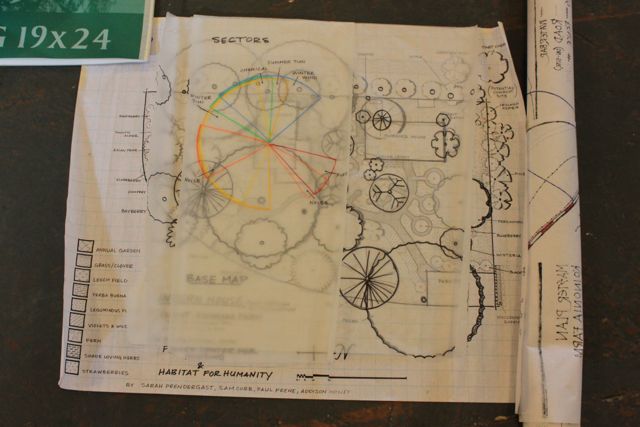
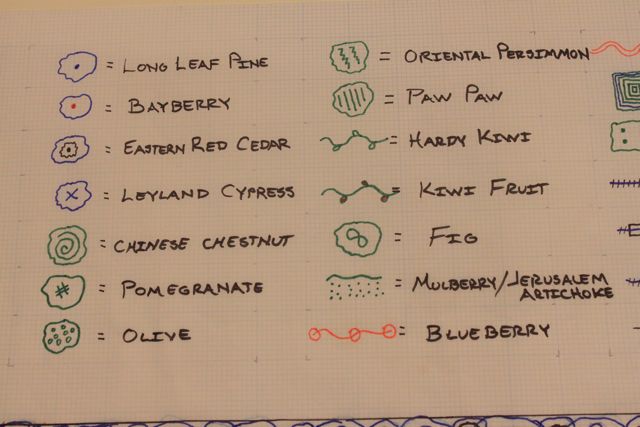
To further delineate property lines, while also providing a physical barrier against chemicals being applied to the abutting land, it is recommended that a natural vegetative boundary be established on the north, east and south sides of the property. The vegetation comprising this boundary should include several evergreen species for year-round protection. These species are primarily native, hardy, and well suited to the climate. The upper-canopy species in this barrier is the longleaf pine (Pinus palustris). The next species to occupy the mid story of the barrier is the eastern red cedar (Juniperous virginiana), followed by bayberry (Molelca cerifera), which occupies the shrub layer. Due to the slow growing nature of these hardy species, the leyland cypress (Cupressus leylandii) was selected as an intermediate species to provide a fast-growing barrier. It is intended that this species be thinned-out as it reaches maturity. The Jerusalem artichoke is an optional species to be considered for inclusion into this barrier. Please reference the site map for planting locations.
Ongoing Maintenence:
In order to provide the space necessary to establish a barrier and construct a fence, the removal of the two easternmost rows of grape vines in the north vineyard is recommended. In the south vineyard, the three easternmost rows should be removed for barrier establishment in that area. These removals will also reduce the maintenance load on the site.
For maximum productions of grapes, pruning is recommended throughout.
A drip irrigation system should be installed for all remaining crops on the site.
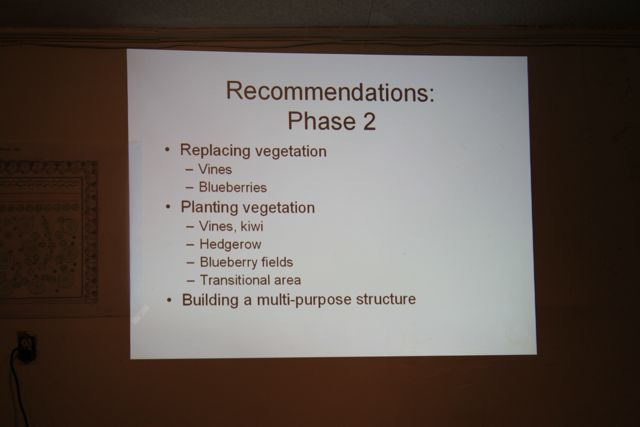
Phase 2:
Replacing:
Research has indicated that existing muscadine vine plantings are approaching the end of their expected productive lifespan and measures should be taken to replace these vines. Since it takes a grape vine 5 years to come to full fruition (SOURCE). To ensure a continued market crop for grapes, a replacement schedule of planting 2 rows per year until all are replanted (10 years in total) is recommended.
To provide even distribution throughout the blueberry rows, it is recommended to transplant blueberry suckers into the open spaces.
Planting:
Due to the density of vines existing throughout the site, the south vineyard should be reconfigured to include only two of the eleven existing rows of grapes. To increase the spacing between the remaining rows to allow for increased access, every other row is recommended for removal. Two trellised rows that have been cleared of their grapes could be used for trellising kiwi (hardy- Actinidia arguta and fuzzy- Actinidia deliciosa) instead.
On the west side of the south vineyard, an edible hedgerow integrated into the system would provide fencing, mulch, diversity and ample forage. White mulberry (Morus alba) is the primary species recommended for this hedgerow, as it fruits on first year shoots allowing for biannual coppicing (cutting for mulch). The Jerusalem artichoke (Helianthus tuberosis), paired with the whilte mulberry, would add to the aesthetics of the hedgerow with it’s beautiful sunflowers while also producing a reliable perennial food crop and a nectary.
The transitional tract of land located on the south end of the blueberry fields can be transformed into a productive and low-maintence orchard. To give an alternative to pecans, the Chinese chestnut (Castania mollisima) is recommended for planting throughout the transitional site, on contour. A variety of trees Interspursed with the Chinese chestnut should include persimmon (Diosypros kaki and Diospyros virginiana), Paw Paw (Asimina triloba), pomegranite (Punica granatum), figs (Ficus spp), hardy pear (Pyrus spp) and olive (Olivio europaea). Growing on the easternmost range, the olive is suggested as a climactic indicator for global warming.
In order to provide an extended season of blueberry harvest and a younger succession for the current blueberry stand, a new section of blueberries is planned for the transitional area directly east of the blueberries.
Building:
A multi-purpose structure for the site would serve as a temporary storage facility for crops, a gathering location for laborers and customers, and a centralized location for “U-Pick” customers. This building would also lend itself to various educational opportunities. This structure should be accompanied by groupings of fig trees, to emphasize the edibility of the site while also providing shade.
To reduce cost and maximize on reusable material, it is recommended that this structure be built from on-site materials. Harvesting rainwater from this structure is of utmost importance, as it will limit the need for outside water in-puts.
Phase 3:
Community Building:
In an effort to provide a family-friendly atmosphere on-site, a playground should be considered.
An interpretive nature trail could also be included into community building. Creative labeling methods such as the use of gnomes along the trail to signify points of interest should be investigated.
Festivals and celebrations would be key to bringing about awareness for the seasons and their bountiful local harvests.
Educational Activities:
Workshops catering to a wide variety of topics from grape pressing and wine production to canning and jamming should be explored.
Dynamic Opportunities:
Seeking out companion plantings to help increase production as well as aesthetics should be explored. One example is the possibility of strategically planting roses with the grape vines.
Incorporating chickens in with the vineyard should also be explored. Research combined with some creativity has given rise to the idea of having chicken runs under the grape vines. Perhaps a moveable hoop-like structure attaching to each side of the grape vine to allow for chickens to run, would be a symbiotic relationship for both grape and chicken. Incorporating a chicken tractor into this design would be a good idea.
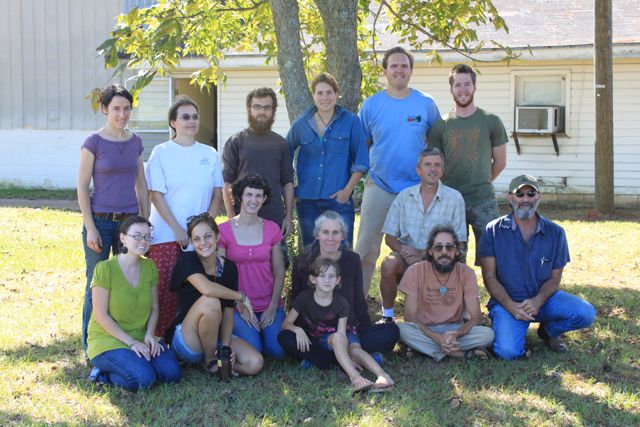
Missing all of you already...