
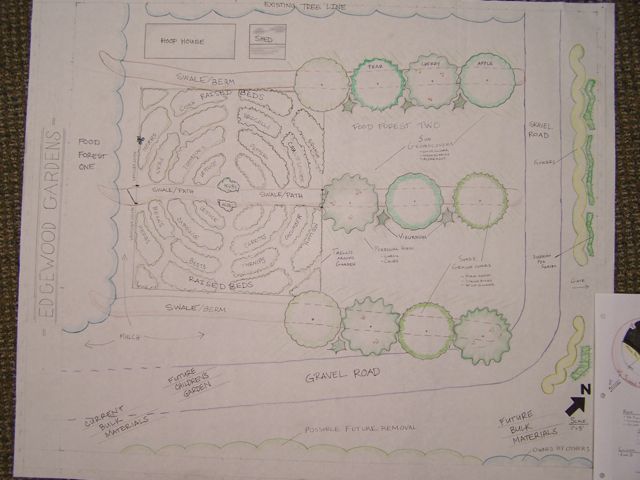
The Edgewood Gardens
Group 3
by
Jerome Case, Annette Ruzcika & Joanne Tooley
Permaculture Design Certificate Course
July 31 – Aug 7 2010
Vision
To create a permaculture garden that reflects the following ethics: care of people, care of earth and the redistribution of resources. This garden provides foods to the various schools found on Edgewood College campus, and over time will contribute to the self-sufficiency of the campus.
Goals
• Increase the local organic food production, plant diversity, and extend the growing season.
• Optimize access and collect surface storm water to minimize the use of municipal water for irrigation.
• Build soil to retain nutrients and moisture.
• Achieve permanence through the plantings of perennials that can perpetuate themselves.
• Achieve abundance through diverse plantings that act as a buffer in adverse conditions and yields under all conditions.
Climate
• Sun
o 40-65% average sunshine hours per day
o 23.5 to 70 degrees altitude
o 60 to 300 degrees azimuth in summer, 125 to 235 degrees azimuth in winter
• Wind
o Mostly out of the South from April until November at 4 to 12 mph
o North Westerly in December, changing to variable through March at 8 to 16 mph
• Rain
o Average 36.5 inches annually
o Precipitation excepted to increase 10-15% each year
o The anticipated 100 year storm is 6 inches of rain in 24 hours
Land and Water
The project site is approximately 145.5 X 125 feet. It is bordered on the north by a small tree stand consisting of hackberry and sugar maple. The east side boundary is fenced from a public sidewalk and Edgewood Avenue. A private residence boarders the south boundary and is fenced with a tall tree stand of mixed deciduous and young conifers. There is an open concrete culvert with a drain on the private property along the fence line. The west boundary of the site is lined with a stand of hackberry and basswood with shrub undergrowth.
• Slope:
o The site has a 7.5 % slope from the north to the south boundary.
o There is a major road and parking lot to the north of the project site that is currently contributing to soil erosion into the project site.
• Soil:
o “Military Loam” (assumed to by ~ silt loam, absorbing 0.4 inches of water in 2.25 hours)
o Black dirt variable, from none on the surface to 8 to 10 inches deep
o Bedrock predicted at from 20 to 60 inches
• Current Use:
o The project site has a vegetable garden approximately 35’X 85’ that contains a variety of vegetables and herbs. It is located in the upper center of the site.
o Along the south boundary are stored piles of bulk materials such has mulch, rock and gravel.
o A dirt access road runs between the garden and material piles and connects to the major road north of the project site.
o The garden receives full sunlight most of the day until mid-afternoon when the tree stand along the western boundary begins to shade the garden.
o There is a water spigot on the western side of the garden.
Proposed Master Plan
The following elements are to be added or changed on the site.
Hoop House
o Allow season extension by providing location for starting seeds in early spring and growing greens in early spring and late fall.
o Provides storage.
o Water access could be routed to inside the hoop house for four season access and protection.
o Relocate shed from Site#4 to be used for additional garden tool storage
Improved road access
o Gravel based to reduce ruts during wet periods.
o Provides access to the south side of the garden and food forest #1 and east side of food forest #2.
o Provides access and delivery of bulk materials.
o In future, this could be shortened, blocked or removed to provide additional garden area.
o Gravel material to help eliminate ruts, erosion and slow storm water run off.
Bulk Materials
o Landscape materials
o Mulch/biomass collections
Flowers
o Along the east side of the project boundary.
o Attracts beneficial insects (ie. wasps, pollinators)
o Aesthetically pleasing.
o Absorbs water run off from gravel road.
o Salt absorptions use Siberian pea shrubs along east boundary line.
Swales
o Three swales crossing the property with spillways into the Food Forest #1.
o 8” – 10” deep with the 12” bottom.
o Provide water catchment accommodating 75 year rain.
o Level with woodchips only in the garden for pathways.
Berm
o Loose soil, easy to plant in.
o Second half of water catchment system.
o High ground for moisture sensitive plant species.
Food Forest #1
o Removed hackberries and shrubs to allow late-day sunlight to reach garden
o Plant raspberries and blackberries with additional dwarf fruit tree guilds designed by group #4.
Food Forest #2
o Plant dwarf apple, pear and cherry fruit guilds.
o Fruit tree guilds providing multi season harvesting of fruit and herbs and nitrogen accumulators.
o Number and diversity of guilds could be increased in the future
Fruit Tree – dwarf cherry, pear and apple
o Provide inexpensive alternative to imported sources of fruit.
o Short duration and fall harvest can be extended by preservation – freezing and canning.
o Providing flowers of various seasonal blooms to encourage continual pollination.
o Provide microclimate (shade, moisture) for other guild plants.
o Carbon sequestration, biomass creation – a source of future mulch.
o Interceptor of precipitation, water storage and redistribution.
o Creates a self-managed system.
Understory – Highland Cranberry
o To attract insect eating birds.
o Various root levels to help prevent soil erosion
o Capture moisture held in the berm.
Ground Cover
o Spring bulbs for early pollination
o Garlic (dynamic accumulator), strawberry for summer food
o Horseradish (dynamic accumulator)
o Asparagus and chives (dynamic accumulator) for early spring food.
o Wild ginger as a ginger replacement.
o White clover for nitrogen accumulation and weed prevention.
Intensive Garden
o Moved west to increase access and allow more room for food forest #2
o Use curved edge to increase the number of plantings.
o Create a three season food production.
o More edge to increase amount of biomass, soil amendments (compost) to create soil structure.
o High diversity of plant species for pest management and manage adverse conditions and yields.
o Grow non-hybrid species by simple propagation techniques.
o Select, dry store and grow seeds.
o Raised planting beds
o Beds are planted based on their managed need (i.e. lettuce and herb are planted closer to the entrance or gate for easy access.)
o Companion planting in all beds.
o Fence and trellis around to support vertical growth
o Gates on east and west side for multiple and through access
Future Improvements
o Bulk materials can be moved into east corner and road shortened to increase land used for gardens
o Children’s gardens could be added on south for increased participation, awareness and education