
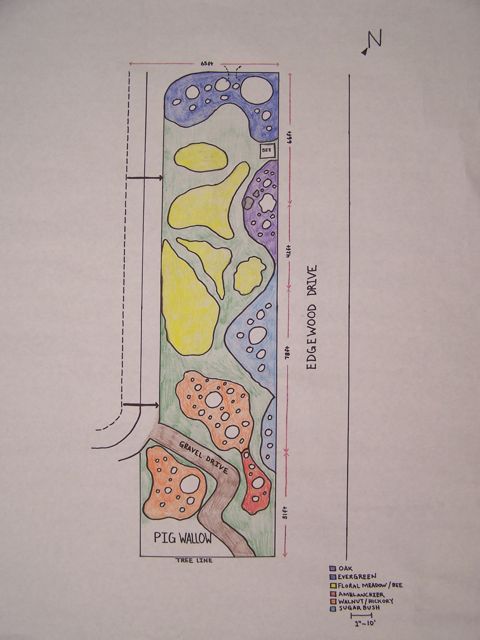
Food Forest Narrative
Group 2
Group 2 was assigned the south facing slope of the eastern-most edge of the Edgewood Campus. The area is 65 feet wide and 270 feet deep with a steep slope dropping from an elevation of 932 feet above sea level to 908.
Geologic and cultivation history The bedrock of the area consists of Pre-cambrian granite, covered by limestone and sandstone, overlaid in areas by glacial till. The hill in question is the leading edge of a glacial drumlin, somewhat modified by construction and road building. The site is in the Wingra watershed, and is part of the Yahara/Rock River system. This slope drains into the northern edge of Lake Wingra.
This area of the state is primarily temperate forest, oak savanna and prairie. The hillside retains some old open-grown bur oak trees, indicating a history of prairie fires. Paintings and aerial photographs show increasing wooded cover on this slope in the 1890s and 1950s, corresponding to settlers’ suppression of fire. The crest of the hill was the site of the Washburn hunting chalet, later the Sacred Heart Academy, and the adjoining acreage was farmed from the mid-19th century. Much of the post-settlement canopy on the hill has been cut and replaced with lawn, sparse gardens, gravel and paved access roads, and erosion. A sector analysis of the area reveals remnants of the natural flora observed in the greater campus area: basswood, hickory, bur oak, black locust, black walnut, hackberry, daylily, mayapple, etc. More recent plantings indicate the intention to reintroduce some of these natives in the area. These include three white pines, and two bur oak saplings, one surrounded by new elderberry plantings. In addition, two balsams, a catalpa and a hop tree have recently been added to the area.
An assessment of the area found that many of the elements present could be built on to create a fabulous food forest. The group developed a multi-stage plan to retain and utilize water in the assigned area, develop the slope into functional food forest guilds, and, once plantings to support animal forage are established, gradually introduce livestock. The food forest utilizes the 7-layer pattern of the forest garden niche as a development guide. This garden niche is a permaculture secondary zone, with greater distance from centers of activity and somewhat less regular traffic.
SITE DEVELOPMENT PLAN
The slope will be developed in a sequential program, starting with water management and planting, and as plans mature, succession pruning and livestock introduction.
Phase I
Water Management
Water management on the slope starts with consideration of the crest of the property. The asphalt drive and parking lot creates an opportunity to channel the water to better serve a productive environment. Our first step is to cut an opening in the curb at the properties entrance to channel water into the property between the driveway and the fence line.
After the driveway turns to the left away from the main parking lot, the asphalt will be removed to be crushed and recycled as a permeable road surface. It is recommended that permeable driveway surfaces are not used for over a 5% slope because of the potential of washing out the underlying foundation. Experience shows that this is not a problem if the foundation is built properly and the surface is maintained annually. If there is a problem or concern, permeable pavers can be used on heavily sloped areas.
Drainage troughs covered by grating will be placed in several areas of the driveway to minimize degradation of the surface with water running to catchment areas in the landscape. The first will be near the top at the edge of the secondary parking lot and channeled into a rain garden cut into the low area just below the upper slope in the assigned area. This rain garden will service the flower meadow/bee guild.
The next drain trough in the driveway will be placed just above the gravel service road to the garden area. The water will be channeled to a swale serving the lower portion of the bee meadow and sugar maple grove. Another rain garden will then be built in the lower portion of the slope between the sugar maple grove and the walnut/hickory guild to collect the balance of the water which runs along the fence. Below the walnut/hickory guild and the Amelanchier guild, water will move toward the garden and associated swales.
The final water management area on the slope is the portion south of the service road between the triangle area created at the curve of the driveway and the treeline east of the garden. This low area will route water to the garden and associated swales, but in Phase II may be utilized to provide water for a livestock-raising area above the garden.
Guild Plantings
Evergreen Guild. Sector analysis of the bare crest of the hill to the north of the food forest suggests a need to deflect winter winds from cold-sensitive fruit trees. An evergreen guild will form a U-shaped windbreak at the north end of the food forest, along the entry driveway. The barrier will consist of an existing blue spruce, two balsams moved from lower on the slope, and the addition of several pinyon pine. The spruce and balsam will become the canopy of the guild and provide a year-round protection to food forest flora and fauna, as well as create micro-climate, extending the growing season for under-plantings in the guild. In the low tree layer the pinyon pines will provide edibles, specialty lumber, soil acidification, additional wild life habitat and windbreak. In the shrub level of the guild blueberry and lingonberry will flourish in the acidified soil providing edibles and medicinal benefits. In the herbaceous layer sweet cicely will provide a fine salad herb with an edible root, lupine will provide critical habitat for the endangered Karner Blue butterfly, and lovage will provide and edible herb with medicinal benefits. Daffodils in the rhizosphere will provide beauty and early forage for bees. Hardy geranium will provide a living mulch protecting the soil and providing forage for bees.
Bee Guild. A fruit and flower meadow will be created on the open slope extending from the south edge of the protective barrier of the evergreen guild to the walnut/hickory guild on the lower slope. Nectary flowers will be interplanted with grasses in the the upper rain garden, on the berms and in the swales, and around the existing catalpa tree. This floral meadow will extend nearly 2/3 of the length of the food forest, though it will narrow the southern most portions to accommodate a sugar maple grove. Multipurpose walking paths will permit enjoyment of the meadow, fruit forage, and orchard management.
In addition to forming a canopy attractive to pollinators, catalpa trees provide lumbar for fence posts, and develop “catawba” worms, a particularly fine fish bait. Dwarf fruit trees will form the low tree layer, providing edibles and bird habitat as well as attracting pollinators. Passiflora, or passion fruit, vines will attract additional pollinators and provide additional edibles. In the herbaceous layer pollinators and beneficials will be attracted by an array of medicinal and edible herbs. Spring bulbs and violets will attract early pollinators. At the soil level, red clover will fix nitrogen and provide additional forage for bees.
Oak Guild. Along the upper fence, an oak guild will be developed, incorporating young existing bur oak trees, which will eventually form a canopy. Hazelnuts in the low tree layer will provide edibles and bird habitat. Berries and sumac in the shrub layer will provide medicinals and edibles, while holly can be cut for holiday decor. Trillium will delight spring visitors. Living mulches at the soil layer, in addition to the usual benefits, will host mycorrhizae and fix nitrogen.
Sugar Bush. A small semi-circular sugar maple grove will be developed along the fence midway down the slope. The understory will consist of spring ephemerals and small trimmed redbuds, but will be mulched with wood chips and remain quite open to accomodate sugaring.
Walnut/Hickory guild. Below the sugar bush, established plantings on both sides of the gravel road will be developed into a large nut orchard. Existing black walnut, shagbark hickory, sugar maple, black locust and hackberry form the canopy of the guild. In the low tree layer mulberry, cherry, and hazelnut will be added. A wide variety of shrubs in this guild will provide edibles, medicinals and bird habitat. Hardy kiwi and muscadine grapes survive jugalone to provide edibles in the vertical layer. Wild ginger will provide a living mulch at the soil layer.
Amelanchier Guild. From the east edge of the gravel access path to the fence an amelanchier, or service tree, guild will be built under the established basswood canopy. The low tree layer will be filled out with hazelnut. Current and gooseberry shrubs will provide edibles, medicinal benefits. Horseradish in the rhizosphere will contribute dynamic accumulation services as well as spicing up the lives of guild visitors. Living mulch of strawberries and red clover will fix nitrogen.
Phase II
Plant Succession
As managers of permaculture forests we facilitate succession in the ecological communities we create. As we build our guilds we increase the diversity of ecological community. As our plantings mature, more vigorous individuals may need to be checked or we may remove some species in order to encourage others. In this area, we expect to remove leguminous black locust as the other trees in the Walnut/Hickory guild gain height and girth. Some of these trees may be coppiced. These trees fixed nitrogen in the soil and supported the growth of the guild in its early stages. We also expect to be able to sustainably harvest young hackberries for fence posts and livestock fencing.
Livestock Introduction
Current neighborhood planning processes are often characterized by significant resistance to introduction of new elements. Education will be required in order to develop local tolerance and support for urban animal agriculture.
Assuming a successful community outreach, the first step would be to introduce bees to the flower and fruit meadow. A platform for bee hives will be located along the fence just south of the spruce. The hives will be elevated to minimize intersection of the flight paths of bees and strolling humans. Workshops on beekeeping, candle dipping and cooking with honey will enhance neighborhood support for apiculture.
Wild turkey already forage in the nearby University Arboretum, and given appropriate mast crops, could establish themselves in the food forest. The shaded area at the lower end of the walnut/hickory guild is both close enough to crop scraps and secluded enough to permit raising of pigs in a small paddock, where careful husbandry would reduce odor and noise.
Food Forest Plant Guilds
Group 2
Evergreen Guild – Planted at the at the top of the north edge of food forest
Blue spruce (1) (large existing tree on site) windbreak, micro climate protector, shelter for beneficials, soil acidifier
Balsam fir (1) windbreak, chewing gum, glue, firestarter, wildlife habitat
Pinyon pine (2) pinenuts, specialty lumber, soil acidifier, windbreak, wildlife habitat
Blueberry (3) fruit, medicinal
Lingonberry (3) fruit, medicinal
Sweet Cicely (4) salad herb, edible root
Lupine (4) critical habitat for endangered Karner Blue butterfly
Hardy geranium (4) living mulch, medicinal
Lovage (4) edible herb, medicinal
Daffodil (4) spring happiness, early nectary
Oak Guild – along fence on upper slope
Bur oak (1) acorn flour, lumber, wildlife habitat
Hazelnut (2) nuts, flour, bird habitat
Hardy holly (3) bird habitat, holiday decor
Elderberry (3) medicinal, fruit, jelly, wine
Sumac (3) medicinal, wildlife habitat
Currant, gooseberry (3) fruit, jelly
Blackberry (4) fruit, jelly, wine
Trillium (5) spring happiness
Bearberry (6) medicinal, tea, wildlife habitat, nectary, nitrogen accumulator, mycorrhizal host
Alpine strawberry (6) fruit, jelly, ground cover
Flower and Fruit Meadow/Bee Guild – Planted in upper rain garden, and on berms and in swales, on upper meadow parallel to road
Catalpa (1) lumber, esp fence posts, nectary, fish bait (worms)
Dwarf fruit trees – Apple, Pear, Plum, Cherry (2) fruit, jelly, nectary, bird habitat
Passiflora (passionfruit) (7) juice, nectary
Rugosa rose (3) rosehips, nectary
Chelone (turtlehead) (4) nectary
Monarda (bee balm) (4) tea, nectary
Echinaceae (coneflower) (4) medicinal, nectary
Mints, alliums, garlic, dill, parsley, caraway (4) edible herbs, beneficial insects esp pollinators, ground cover (mint)
Spring bulbs (5) spring happiness, early nectary
Red clover (6) nitrogen fixer, ground cover
Amelanchier Guild – lowest guild on slope
Basswood (large existing tree on site) (1) salad leaves, lumber, nectary
Amelanchier (serviceberry) (2) fruit, jelly, bird habitat
Hazelnut (2) nuts, flour, bird habitat
Currant, gooseberry (3) fruit, jelly
Comfrey (4) dynamic accumulator, medicinal
Mints, lemon balm, borage, dill, parsley, coriander (cilantro), other aromatics (4) edible herbs, beneficial insects esp pollinators, ground cover (mint), medicinal (lemon balm)
Horseradish (5) dynamic accumulator, edible root, medicinal
Strawberries (6) edible fruit, nectary, ground cover
Red clover (6) nitrogen fixer, ground cover
Walnut/Hickory Guild – grove above pig wallow, and across gravel road (this guild occupies a large area, and includes both sun and shade)
Black Walnut (1) nuts, lumber, wildlife habitat
Shagbark Hickory (1) nuts, lumber, wildlife habitat
Sugar Maple (1) sap, lumber, bird habitat
Black Locust (1) nitrogen fixer, nectary, livestock fodder, delightful flowers, medicinal, fritters, coppice, firewood, lumber, wildlife habitat
Hackberry (1) edible seeds, wildlife habitat
Mulberry (2) berries, jelly, bird habitat
Cherry (2) fruit, bird habitat
Hazelnut (2) nuts, flour, bird habitat
Hardy Kiwi (7) fruit
Muscadine grapes (7) fruit, jelly, wine
Rugosa rose (3) rosehips, nectary
Elderberry (3) fruit, jelly, wine
Currant, gooseberry (3) fruit, jelly
Hoptree (wafer ash) (3) medicinal
Raspberry, quince (4) fruit, jelly
Echinaceae (coneflower) (4) medicinal, nectary
Daylily (4) edible roots
Mayapple (4) edible fruit, medicinal
Dandelion (4) dynamic accumulator, salad, medicinal, wine
Trillium, Claytonia, spring bulbs, violets (5)
Wild ginger (6) ground cover, medicinal