
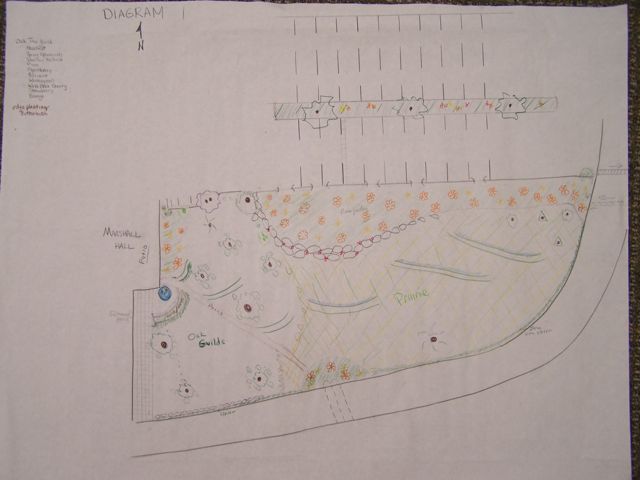
We divided the students into four groups, each group working on land parcels at the top of the watershed of Edgewood College. Here is the narrative from the first group. I will be posting the other three narratives as they come in:
Group 1 Design – Oak Savanna
Barb Anderegg
Kristin Bogardus
Janet McConaughey
Susanne Smebak
Rationale
Plot 1 has the following characteristics:
• Climate
Madison is a temperate climate, with an average of 30-40 inches of rainfall per year and an average of 40-50 inches of snowfall per year. This is a major factor in the design of Figure 1.
• Water
Edgewood College campus is one of the watersheds feeding directly into Lake Wingra. Direct surface runoff into the lake carries excess nutrient, soil sediments, and many pollutants into the lake before they can be filtered and cleaned. More information can be found about the conditions of Lake Wingra at http://lakewingra.org/. Most of these issues can be resolved by holding as much water in the soil as possible at higher elevation and allowing for filtration and cleaning of this water before it makes its way into the lake.
• Access
The parking lot requires plowing as does the access road running east to west at the southern border of our site. This access road appears to be used mainly by maintenance vehicles at this time.
• Microclimate
This is a south-facing slope; the west end is shaded by Marshall Hall in the mid-late afternoon. It is a fairly sheltered area, the white pines and white oaks planted in the NE corner provide a windbreak. The centrally located rain-garden is bordered by large boulders that create a slightly warmer microclimate in their immediate area by holding and releasing heat.
• Vegetation
The current landscaping now consists of lawn, requiring mowing, possibly fertilizer/broad-leaf herbicide, and spot re-seeding each year because of erosion. As mentioned previously, this area sheds water quickly and as is, does not slow down and hold much water within the soil. There are mature canopy trees (oaks, linden, ashes and mulberries) located mostly on the Northwest corner of the site that we would like to retain. Also at the Northeast corner, the young white oaks and white pines that are planted act as a windbreak for the majority of plot 1. Just south of the parking area is a rain garden that catches a lot of the run-off from the parking lot. This is full of many mature flower plants and grasses as well.
• Zones of Use
The upper access to Marshall Hall appears to be used primarily as an entry/exit only. There is a picnic table available but not many signs of localized activity. It is, however, in a nice location that would be ideal for developing into a patio, or seating area.
• Soil
The current soil is a nice loam that washes easily downhill. Retaining this soil in the landscape will encourage healthier plants.
• Aesthetics
The most immediate need from an aesthetic point of view is the rock drainage culvert system currently sited in the middle of the southern edge of plot 1. By implementing the proposed design, the need for this drainage system should be eliminated. The mature trees provide high shade, the rain garden softens the edge of the pavement hard-scape and also provide for seasonal interest.
Located at the point of highest elevation on the landscape, the site has severe runoff problems creating erosion especially below the access road. Attempts to remedy this include a rain garden system at the top of the slope as well as attempts at controlling the flow of water with the rock drainage and culvert. However it is evident in plot 4 that the water is not being managed, just redirected. The current impermeable paved surface at the ridge creates a current of water each time it rains. This parking area is a necessary part of the campus and likely can’t be eliminated. Water run-off from the dorm roof is also directed out onto the lawn, further contributing to the run-off. As the water moves down from these high points, it converges at the culverts underneath the road downhill causing heavy erosion. In heavy rains, sheets of water rush over the top of the road rather than following the culvert beneath the road.
Design Plan
Phase 1
As mentioned, the severe erosion problems begin at the parking lot, the highest point in the landscape and also continues down the road. The current impervious blacktop can be recycled to create a permeable blacktop. At the top of the access road, we will add 2 in-road grates that end in rain gardens in plots 1 and 2, respectively. We will also add rain gardens and trees in the median strips of the parking lot. This will help to hold water as well as provide shade for parking. These changes are diagrammed in Figure 1.
We will extend the existing rain garden to the road and make it wider to better collect run-off from the road grate. The emergency phone will move to the parking lot. We will regrade the outer edge of rain garden, adding plants such as strawberries and mints
Oak savanna. We will retain mature trees on the property to form the food forest area. Table 1 includes the plants that we will add to the food forest.
Table 1. Oak Savanna Plants
Quince Hazel Plum
Gooseberry Currant Raspberry
Blackberry Blueberry Wild grapes
Wild black cherry Wintergreen Lignonberry
Goji berry Goumi Baptisia
Siberian pea shrub Spring ephemerals Mints
Hollyhock Rosa rugosa Persimmons
Just off the handicapped parking area, we will add a rain garden, anchored with pussy willows and traditional rain garden plantings. A water catchment system will catch rain from the dormitory roof and store it in a holding tank for use in gardening and emergency backup.
Prairie. We will add 3 swales to mid-level region as shown in Figure 1. The swales will act to slow the speed of the water moving downhill and allow it to soak into the landscape. Throughout this area, we will plant a high-grass prairie. Advantages of a high-grass prairie include:
• Reducing maintenance and watering needs
• Reducing fertilizer and pesticide applications
• Controlling erosion and recharging water tables that support wildlife habitats
• Enhancing aesthetics
• Merging natural and cultural heritage links to create a unique local identity
We will plant prairie plants as listed in Table 2.
Table 2. Prairie Plants
Monarda Bluestem grass Butterfly weed
Asters Prairie smoke Toadflax
Prairie sedge Sideoats grama Wild rye
Porcupine grass Indian grass Prairie dropset
Penstemon Slender mountain mint White prairie clover
Tick Trefoil Boneset White sage
Heath aster Yarrow Prairie Indian plantain
Milkweed Liatris Shooting star
The ecotone where the oak food forest and the prairie meet will provide an optimal edge to reduce erosion and solve water holding issues.
Phase Two
After implementing the above mentioned design plans, phase II will consist of observing how the water is managed and determining if any further additions need to be made. Because the rock drainage and culvert system are the lowest point in the landscape, all drainage is effectively channeled in that direction and will be marker for how effective the rain gardens and swales work to hold water within the soil. For aesthetic reasons, the ultimate goal is to fill this drainage/culvert in and blend it with existing contours and plant fruit trees which will be easily accessible from the garden. In Phase 2, we will start to see whether we can take steps toward this goal. We will start by adding a permeable rock facing to the culvert drains and by taking out the unsightly rock terrace that currently exists. Soil and rain garden planting will help to further hold water and soil in the landscape but the culverts can still function to drain off excess water if it is needed.
We will also add a small berm along the edge of the road to keep water in the prairie and plant it with white clover. This will alleviate the current practice of spraying herbicides to control the weeds in the existing rock edging.
Phase Three
We will observe the system for a year. If we still have erosion and runoff problems, we will add more swales in the middle levels of the site. We will also consider converting the culvert into a holding pond. The pond will be surrounded with marsh plants to mitigate the salt from winter snow removal. The spillway from the pond will go through the existing culvert drains and under the road into complementary Zone 4 interventions.
Also, if the current plan cannot completely control the run-off down the access road, we suggest redirecting the road to come in directly from Edgewood College Drive and not be connected to the parking area. Then that steeply sloped area can be planted to stabilize the hillside.
Social implications of our design
We have discussed how we can make this space more inviting and useful to students and staff as we implement our design. Specific ideas include:
• Creating pathways and seating areas through the oak savanna and prairie
• Making use of unique design elements such as live willow benches (Figure 2)
• Investigating how individuals and the school cafeteria may use food from the oak savanna and prairie
Modifying the buildings to include:
Modified and expanded patios
Screened porches along the side of the building
Pots of growing plants and trellises to cool the patio area