
I will be posting the final projects from this year’s Michigan PDC over the next couple of days. Enjoy.


Swan Lake Island
Clark Tibbet’s Permaculture Project
Introduction:
Swan Lake Island is a part of the Land Stewardship Center or LSC in Columbiaville, Michigan. The LSC is interested in protecting and enhancing the health and beauty of the land and observing sustainable land stewardship practices. The Tibbits Farm, the home of Swan’s Island and LSC, was the first farm in Michigan to be protected by gift of a conservation easement to the American Farmland Trust. Permaculture design principles are used to create a place of peace, plenty, beauty and solitude on the land.
Climate, Topography and Planting Zone:
Michigan weather in this Great Lakes region is affected by both warm, humid air from the Gulf of Mexico and cold, dry air from the Arctic. The entire basin experiences four distinct seasons and is influenced by the Great Lakes. Acting as a giant heat sink, the lakes moderate the temperatures of the surrounding land, cooling the summers and warming the winters. This results in a milder climate in portions of the basin compared to other locations of similar latitude.
The temperatures at the Swan’s Island range from an average of 20 degrees in the winter to 78 degrees in the summer. The microclimate at Swan’s Island is influenced by the Halloway Reservoir which wraps around the town of Columbiaville. The annual precipitation is 30.3 inches and annual snowfall is an average of 44.6 inches. There are an average of 66 clear days a year, 105 partly cloudy days and 195 cloudy days.
Swan Lake Island is located 852 feet above sea level and the change in elevation from the top of the island to the water is approximately 20 feet. The island is in USDA planting zone 6A. All of the plants we have recommended for this project are approved for growing in planting zone 6A. However, the success of the growth will depend on the quality of the soil (which is boosted by the addition of organic matter), the days of the sun. the amount of water and the temperatures the plants are exposed to.
Clark’s Goals: (not in any specific order)
- Grow food because the deer only cross in the winter.
- Make it beautiful for retreat purposes. No needs for a building as there are no visitors in the winter.
- Maintain the established observation points at the top of island. Specifically the meadow view.
- Shade is a consideration.
- Ease of maintenance.
- Would enjoy a landing spot for the canoe.
- Enhance the spirit of meditation throughout the island.
- Honor the purposeful plantings that are already established in the meditation garden. ie. Rocks, red maple, bowl of water and certain plants that have been planted for their colors.
- Have privacy – out of site areas.
- Identification plates/tags for species and specific areas/guilds.
- Budget is $100-$150 for trees and $50-$100 for benches, dock landing. Utilize local/free and recycled resources.
- Meandering paths around the island that invite peaceful rest and meditation.
- A nut crop would be nice as Clark eats a lot of nuts. There are already butternut, hickory and walnut trees on the property.
- Clark enjoys the sumac lemonade and uses the nettles, garlic, mint and daffodils that are already established on the island. He would also like more elderberry on the property.
- Would be nice to harvest some sort of crop to create an income. As Clark said, “That’d be fine. It’d be one less day that I’d have to work.”
Our Goal:
To meet all of Clark’s wishes and to create a diverse landscape that is a showcase of permaculture
Our Assessment and Approach:
- We’re dealing with abundant and invasive species of sweet peas, bull thistle and goldenrod and diseased and neglected trees. These issues would be remedied by mowing down all undergrowth invasive saplings and pruning diseased and neglected trees in the fall.
- The larger ‘trees of heaven’ need to be systematically removed over time and replaced with a more appropriate, non-invasive species.
- Sheet mulching and using various ground cover methods in specified areas will kill the old growth. New non-invasive cover crops will be planted. Sumac will be cut back and paths will be cut through for ease of the harvesting the fruits.
Zone Definitions and Descriptions:
We thought Swan’s Island should be divided into 3 zones. Zone 1 includes the entrance to the island, the ‘Welcome Garden’ and the ‘Meditation Garden’. Zone 2 is the area immediately surrounding Zone 1 and down to the mowed path known as ‘Serenity Trail’. Zone 3 is the area between ‘Serenity Trail’ and the water that surrounds the island.
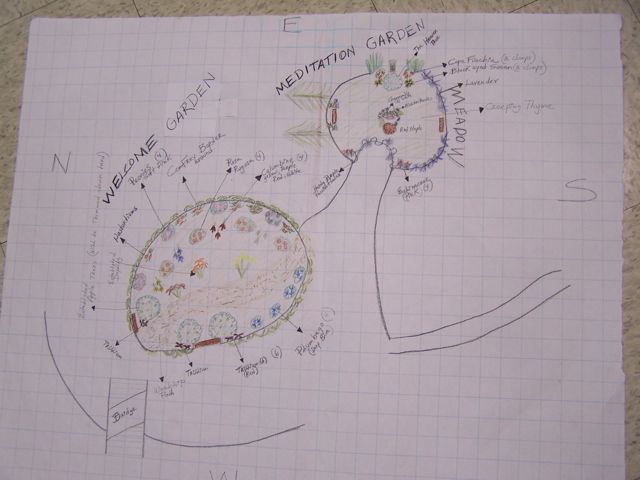
Zone 1 The focus in the ‘Welcome Garden’ will be on supporting the established grape vines and flowering species. Perennial flowering plants including rosa rugosas, peonies and nasturtiums, plumbago, columbine, and hardy trillium in white and red will be added. There will also be a border of comfrey around the entire garden and 2 long benches. Each plant will have it’s common and Latin name to identify it.
For the entrance to the ‘Meditation Garden’, over the trellis, a native passion fruit and an orange honeysuckle that attracts hummingbirds will be planted.
In the ‘Meditation Garden’ the focus will be on herbs including the established thyme, oregano and planting in lavender and mint. Having edible miniature pansies would also be lovely. There will also be bluebeard thyme added along with hyssops, chamomile, and cape fuchsia. Note that there is also an established evergreen windbreak towards the north in this area. The 2 hedges that are currently separating this zone from Zone 2C will be replaced with hazelnut bushes.
Zone 2A From the ‘Welcome Garden’, along the ‘Serenity Trail’, we’ll propagate the roots of the Echinacea to create an established 10 ft. bed. A comfrey border will separate the Echinacea from the mixed wildflower gardens. Wildflowers include yellow and pink lupine. Another border of lavender will extend from the south end of the bench in the ‘Meditation Garden’ down to the ‘Serenity Trail’.
Zone 2B As you enter into zone 2B, there will be a guild of hazelnut trees along the bottom of the zone. The cover crop with the hazelnuts is patty pan and delicata squash. The flowers from the patty pan squash are edible. We decided to dig a swale in this zone to hold some of the water from the slightly steep incline due to noticing it was a dry area. The berm just above the hazelnuts is the home for the vibrant red flowering amaranth which will be aesthetically pleasing and wonderful food for the birds. The comfrey border will lead into zone 2C.
Zone 2C A grassy ground cover is already established in the under-story. We will plant flowering dogwood trees and 3 pecan trees. The idea is to establish a hardy tree base in that zone so eventually the larger established ‘trees of heaven’ can be removed. An American ginseng patch will be planted close to the ‘Welcome Garden’.
Zone 3A From the bridge, the first thing you notice is the established climbing native grape vine. Walking along the ‘Serenity Trail’, to the right is the red sumac which will be pruned and pathed with mulch. The sumac flowers make a nutritious substitute for traditional native beverage resembling lemonade. As we leave the sumac, the 2 Asian pear trees will provide delicious fruit and the lingonberries are great for the liver, delicious for jams and for the birds. This area would be heavily mulched to choke out the sweet peas and the white clover ground cover would be established in the second year.
Zone 3B The first thing we had to do in this zone was to mow the goldenrod and sheet mulch. A clump of gooseberries separates this zone from the previous one. We then have 2 Japanese persimmon tree guilds with an 8 ft. diameter mulch with a comfrey border around each. The persimmon an early fall crop. In the middle of these two is the Kentucky Coffee Bean tree. There are also scattered hazelnut bushes and the ground cover is chicory. A clump of currants separates this zone from the next one.
Zone 3C This section is dedicated to large yellow-groove bamboo which is a good cash crop and good for building. The transition leading into zone 3D is elderberries.
Zone 3D The narrow entrance into Zone 3d is covered in raspberry brambles. As you enter the wider area, three mulberry trees have been planted with a weeping willow tree in between. Around the willow tree for the ground cover in this area is turtleheads and daylilies. Eventually we think bunchberry, wild ginger and wood sorrel would be nice in this area. A canoe landing visible from the main house and new visitor center will be built near the bridge with flat local stones stepped and terraced to the water’s edge for easy canoe access.
Submitted by:
Midwest Permaculture’s 2010 Columbiaville, MI,
Permaculture Design Certification Course
Members:
Lili Alvarez
Sonia Bremar
Benton and Noah Childress
Miles and Gavin Riley
Linda Wemhoff